Building Authority in an AI World
Episode Summary
In the AI age, we assume the deepest expertise wins. It doesn't. Knowledge is now abundant and nearly free, so the scarce assets are trust and relationships — and they go to whoever surfaces first. Adam Witty, founder and CEO of The Authority Company and a 20-year veteran of turning founders into recognized authorities, explains what changes when buyers stop scrolling through Google results and start asking an AI tool for the one name that matters. His argument: authority matters more than ever, but only if it's authentic.
About the Guests

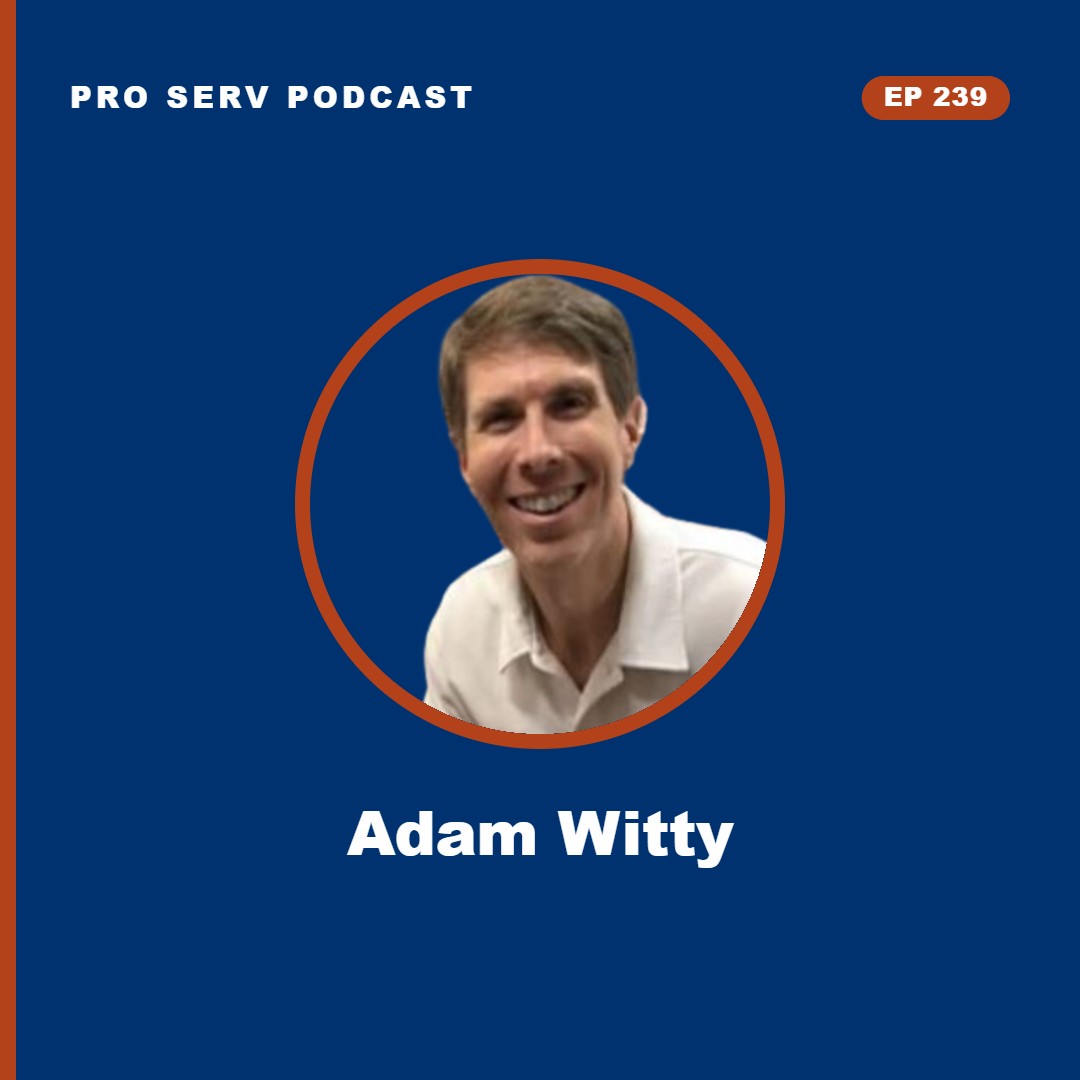
Adam Witty is the founder and CEO of Advantage Media and Forbes Books, a business book publishing platform that has served over 2,000 authors across 44 U.S. states and 14 countries.
Key Takeaways
- Why the shift from SEO to "answer engine optimization" ends the democracy of search — where one or two cited sources win and everyone else becomes a ghost
- Why leaning on AI to mass-produce content backfires: the LLMs are built to detect and disregard artificial content and to reward authentic, authoritative voices
- The "thought leader with something to teach vs. operator with something to sell" mindset, and why leading with education lowers a buyer's guard
- Where owned, earned, and rented media (like LinkedIn) actually fit — and why rented media carries the lowest authority
- Why writing and publishing a book is the single best way to get cited and sourced by AI
- A four-step personal brand audit you can run this week
Full Transcript
Jeff Klaumann: Hey everybody, welcome to the Pro Serv Podcast, brought to you by Collective 54. I'm Jeff Klaumann, I'm the president of Collective 54. If you're new to the show, here's what we're all about — helping you do three things: make more money, make scaling easier, and make an exit achievable. Everything we record here is built exclusively for boutique professional services firms. So if you're in the expertise business, if you market, sell, and deliver expertise, this show is for you.
We have a great, yet uncomfortable topic today. In the AI age, we often assume the deepest expertise wins. It doesn't. Knowledge is abundant and nearly free now, so the scarce asset is trust and relationships. Trust goes to whoever gets surfaced first, and relationships are built upon that trust. Try it — ask an AI tool who the expert is in your field, and a name will come back. If it isn't yours, it's probably a competitor's, and that's the new front door.
So, to help us think through this, I have Adam Witty on the show. Adam has spent 20 years turning founders into recognized authorities. He's a Collective 54 member and partner, and the founder and CEO of Advantage Media. I've known Adam for a few years, and I can tell you he is a true expert on building authority. So, Adam, welcome to the show. Before we jump in, would you give the audience a proper introduction to you and your firm?
Adam Witty: Yeah, Jeff, thank you so much — a pleasure to be with you. And I'm not only your podcast guest, I'm also a customer. As you mentioned, we are proud ERA 3 members of Collective 54. We are also proud ecosystem partners of Collective 54 as well, and have had the honor of helping a number of C54 members build their authority to grow and scale their business.
So, my story, very briefly. I started Advantage in 2005 — some 21 years ago. I had no dreams as a child of being a publisher, but like so many, the opportunity found me. A very dear friend and mentor to me when I was a young man was a guy by the name of Pat Williams. He was the founder of the Orlando Magic, which was the community where I grew up as a child. And Pat Williams, aside from being a notable sports executive, over the course of his lifetime authored 110 books. And Pat Williams will tell you that those books helped make him even more famous than he was before. Those books opened a door for him to speak and travel all over the world, to be on the Today Show and Good Morning America, and to literally build a network of friends that anybody who's a sports fan would drool over. Pat said to me, he said, Adam, when the CEO writes the book on the topic, they become the authority that everyone goes to.
Pat knew about my two years as a summer intern at a publishing company, and that's all it took. With that little bit, he said, Adam, you need to be the Sherpa that helps CEOs write and publish a book. And that nudge, which he gave me some 21 years ago, has now resulted in Advantage becoming the largest independent business book publisher in the world. We have five publishing imprints — Forbes Books, South by Southwest Books, Entrepreneur Books, Advantage Books, and Rethink Press. This year we'll publish 320 new titles. We serve over 2,500 authors and authorities in 48 U.S. states and in 30 countries. We were founded and headquartered in Charleston, South Carolina, and we also have offices in London and now in Dubai. We are truly serving a global audience.
Jeff Klaumann: Fantastic. Well, for another time we'll have to talk about Pat Williams — I actually got to see him speak once at an event, so we'll have to revisit that.
Okay, so you've spent 20-plus years making founders famous for being an expert. Now you're telling those same founders that being an expert isn't enough anymore. What's changed?
Adam Witty: Boy, a lot has changed. Let's talk about one big change that really says everything, and that is the shift from SEO to AEO.
For probably the last 15 to 20 years, the game was all about creating content that is relevant to the searches that people are putting into Google. We as entrepreneurs and business leaders were taught this thing called content marketing — that we needed to create keyword-rich content, publish it online, and the way that a buyer would find us would be by doing a search, and ideally, if we played the game right, we would come up first.
Now, the one really important thing to know is that SEO really was true democracy. If you typed in a keyword, you would have 20-plus pages of results. Of course, the winner was most likely the person or firm that showed up on the first page — probably the first half of the first page. But still, it was a democracy, which means that if you were ambitious, you could spend hours combing through every single search result, and you had the ability to choose who you wanted to listen to, who you wanted to buy from, where you wanted to go.
Everything is now shifting from SEO to AEO. Most people are using Claude as their search engine, they're using ChatGPT, and certainly if you're on Google, the first thing that's going to happen is that as soon as that search result comes up, it's going to go into AI mode and Gemini is going to try to give you the answer versus the legacy Google search system.
So for anybody that thinks AEO is democracy, you're wrong. The LLMs are taking all of the information that's out there and instead of giving you the opportunity to sift through it all and choose who you wanted to listen to, the LLM is sifting through it for you, and it is making the decision — who is most relevant, who is the biggest authority, and who is the person they're going to cite and source in the answer they supply to you. Before, you had 20 pages of answers. Today, you have one answer with probably one or maybe two sources that are cited. And if you're not that number one or number two, you've become a ghost, and you officially disappear.
Jeff Klaumann: Well said. I mean, we went from a time when you just wanted to get on the field, and now you have to get to the end zone, or you're not even in the game. So it is a very different change.
So what does a boutique founder do now, knowing this change in the market?
Adam Witty: Yeah. For the last 20 years, authority mattered — in the context of being relevant, being searchable, and showing up on the first page of Google. Authority still matters. In fact, I would argue that authority matters more now than ever before. But there is a caveat, and the caveat is it must be authentic authority — it cannot be artificial.
Now, the first mistake that a lot of people will make is they'll say, Adam, I never had the time to do all of that content marketing before, but now that I have AI, I'll just let it do it all for me. The problem, however, is that by pressing the easy button, yes, you can create a plethora of content, but none of it is authoritative and authentic, because it's a machine doing the work instead of you as a human. It doesn't mean that AI cannot be used as a tool to help make the job of authority marketing easier, but it cannot replace the job that you have to do. The AI engines, the LLMs, are seeking out authentic, authoritative voices to cite and source in their answers — but machines can detect machines better than humans. All of the big players, whether it's Anthropic, OpenAI, or certainly Google, have built their algorithms to teach the LLMs what to give preference to and what to completely disregard. And they're going to disregard the mass-produced content that many people are opting for — content that is not authoritative and is artificial.
So what is a founder of a boutique to do? Number one, you need to lean into this. Number two, I'm not an alarmist, but you need to heed this warning and pay attention now. Because once the LLMs make up their mind as to who the voices are that they're going to cite and source, it's very hard to get them to change their mind. So there is a first-mover advantage, an advantage for people who are proactively managing this. You've got to pay attention, you have to take action now, and you have to authentically create educational-based content that truly adds value to the decisions that are facing your ideal client profile right now. This isn't about how do I make more sales — this is all about how do I add more value to these people's lives. If you make that your North Star, then you will win in this world.
The last thing I'll say — a big part of what we do is helping people write and publish books, and I promise you this is not a setup for what we do — the number one way to be cited and sourced by LLMs is to author a book. The reason is that the LLMs have been trained by their creators to crawl every publicly available published book, and they treat books as tomes of knowledge, whereas what's on a website, let's face it, is marketing copy. The preference that content from books gets is significantly over-indexed compared to all of the other content that's freely available online. So, hands down, writing and publishing a book is the best way to get cited and sourced in LLMs.
Jeff Klaumann: Makes perfect sense. It's a heck of a lot taller order to write a book than it is to publish a thousand-word article, so it makes perfect sense.
So I want to pull on a thread you mentioned about education. You're saying you have to show up as a teacher, not as a seller — and oftentimes that's a hard shift for founders to make, especially when you've gotten to where you are by selling, by going to network events, by always shaking hands and trying to be in sales mode. So let's talk about some of that shift and how a founder needs to think a bit differently when it comes to building authority.
Adam Witty: Yeah. We say all the time — are you a thought leader with something to teach, or are you an operator with something to sell? And the truth is that most entrepreneurs, you're an entrepreneur because you could sell, right? You had an idea, you sold it, and you spun up a business behind it. What I'm encouraging all of the listeners to do is not to fundamentally change who they are, but just to tweak the approach.
And the approach is that if you lead with education, you will actually attract far more people to you and your message than if you are overtly trying to sell. When someone is simply teaching you something, your guard is down. But when you sense, oh, this is really a sales pitch, immediately the walls and the defense mechanisms go up, and you challenge and are skeptical of everything that comes out of this person's mouth. So just by changing the thinking of who you are and what you're doing, you're actually going to be more effective as a salesperson — because the audience you're trying to reach doesn't have their defense mechanism up.
But the second thing is that every entrepreneur I've met, Jeff, believes in what they do, and they love helping their clients get to a better place with the solutions that they provide. So with that same altruistic spirit — just like you want to help your clients get to a better place — just treat this as, hey, I know something that could help them get to a better place. If I simply teach them and share with them everything that I know, number one I'm going to help them, but number two, those who are so moved by what I teach are going to quickly raise their hand and say, hey, can I just hire you and your firm to do this for me?
Jeff Klaumann: Exactly. One of my great golden rules is offer value first, sell later — and that really echoes what you're describing there. It is a bit of a hard shift at times, but like you said, as founders and entrepreneurs we like to help our clients solve their problems, so lean into that more. Selling can come later.
Adam Witty: Nobody likes to be sold, but everybody sure does like to buy. And so if you approach it as a salesman, people feel that they're trying to be sold. If you approach it as, hey, I'm just an educator trying to add value, then that's going to open up the door for — I want to buy from this person.
Jeff Klaumann: Right, exactly. So, we've talked previously about rented media, and you have a strong point of view about it. Before we dive into your thinking, why don't you take a moment to define what you mean by rented media, so we're all operating under the same level of understanding.
Adam Witty: Yeah. So I'll quickly say that we believe every entrepreneur, every pro-serv founder, needs to see themselves as a media company. And there are three types of media: owned media, earned media, and rented media. So let's talk about rented media. What is it? It is you renting space on someone else's platform. Now, rented media is quite frankly the most popular form of media there is, and the reason is that in most cases, at least it appears that the media is free. For you to create a LinkedIn account, an X account, or a Facebook account, it is free financially — but things of enduring value are oftentimes not free.
So what we have to realize about rented media is it's someone else's platform, it's someone else's set of rules, and of course it's ultimately their audience. They're just loaning you temporary access to that audience.
Now, the reason rented media does matter and should not be completely discarded is that the LLMs do pay attention to what's happening on rented media. In the case of social media — the most credible platform that would help a founder of a pro-serv firm is LinkedIn. The LLMs do crawl LinkedIn, and they do pay attention to your LinkedIn profile. How robust is it? How many connections do you have? What kind of content are you sharing in your posts? Does it link to books you've written, to videos, to white papers? So the reason that everybody should have a robust LinkedIn presence — and not the picture of a shadow of a person when I click on your page, meaning you've never even uploaded your picture — is because it does make a difference when it comes to being cited and sourced.
Now, the one thing about rented media I will say is that the lowest authority is attached to this form of media, because it also has the lowest barrier to entry — anybody can create a LinkedIn account. And of course you have to be very careful, because you don't own the platform, you truly don't own the audience, and they can change an algorithm or change their rules at any moment, and it can completely disrupt everything you've been doing on it.
Jeff Klaumann: Yeah, 100%.
Okay, Adam, we're just about out of time, so one final question. If a founder did exactly one thing this week, what should it be?
Adam Witty: Great question. I'm going to give every founder a little bit of homework. And the homework is — in the AI world we're currently in — I want you to conduct your personal brand audit. I'm going to give you four quick things to do that make up that audit, and I'm serious, this is homework.
So the first thing is Google your name. Now, I would recommend you not do it in the presence of your spouse — they probably already think you're a narcissist, but when they see you Googling your name, that will only confirm what they already thought. Here's the question: are you at the top when you Google your name? Or do you share that top spot with someone else who maybe has the same name as you? Are your LinkedIn, website, and press all telling a consistent story? That's the first thing. Google your name — do it in legacy search mode, but also do it in AI mode with Gemini.
The second thing — ask ChatGPT, ask Claude, ask Perplexity: tell me about, and then insert your name. Put that prompt into all of the LLMs. The question is: does it find you? Is the information accurate and up to date? Or is AI filling in gaps? We all know that the LLMs have a tendency to hallucinate. If there are gaps, if there are hallucinations, there is work you have to do. Because what you have to remember is your prospective customer is already doing this — they're going to ChatGPT and saying, tell me about Adam Witty, and they're going to believe whatever it says, because they don't know whether it's hallucinating or not.
The third thing is search your industry in an AI query. Go to those LLMs and ask, for example, who are the leading experts in independent business publishing? Do you show up? If not, do competitors show up?
And then finally, the last piece of homework is after you do this audit, it's your job to fix the friction. Do you have a personal brand website? Do you have a LinkedIn page? Do you have a bio page about you on your company website? When is the last press mention you've ever been a part of — was it last week, or was it like 10 years ago? Because AI gives lots of preference to recency. If nothing has been said about you in years, it kind of thinks you're either dead or a ghost. So conduct this brand audit. You may be horrified by the results, and then you'll know what work you need to do.
Jeff Klaumann: Fantastic. Adam, thank you for being on the show — really appreciate it. So, before we wrap up, a couple calls to action. If you're a member, keep an eye out for the invitation to our private member Q&A session with Adam, where you can ask him your questions directly. If you're not a member and today's conversation has you thinking about membership, go to Collective54.com, fill out an application, and we will be in touch. And if you're not quite ready for that, there's plenty more content on Collective54.com, including past episodes and of course insights on our industry. So thanks for listening, and until next time, I wish you the best on your journey to grow, scale, and someday exit your firm.
Related Episodes

Ready to build an AI-Native boutique firm?
Collective 54 is built for founder-led boutique professional services firms. Membership is by application — it starts with a conversation.